
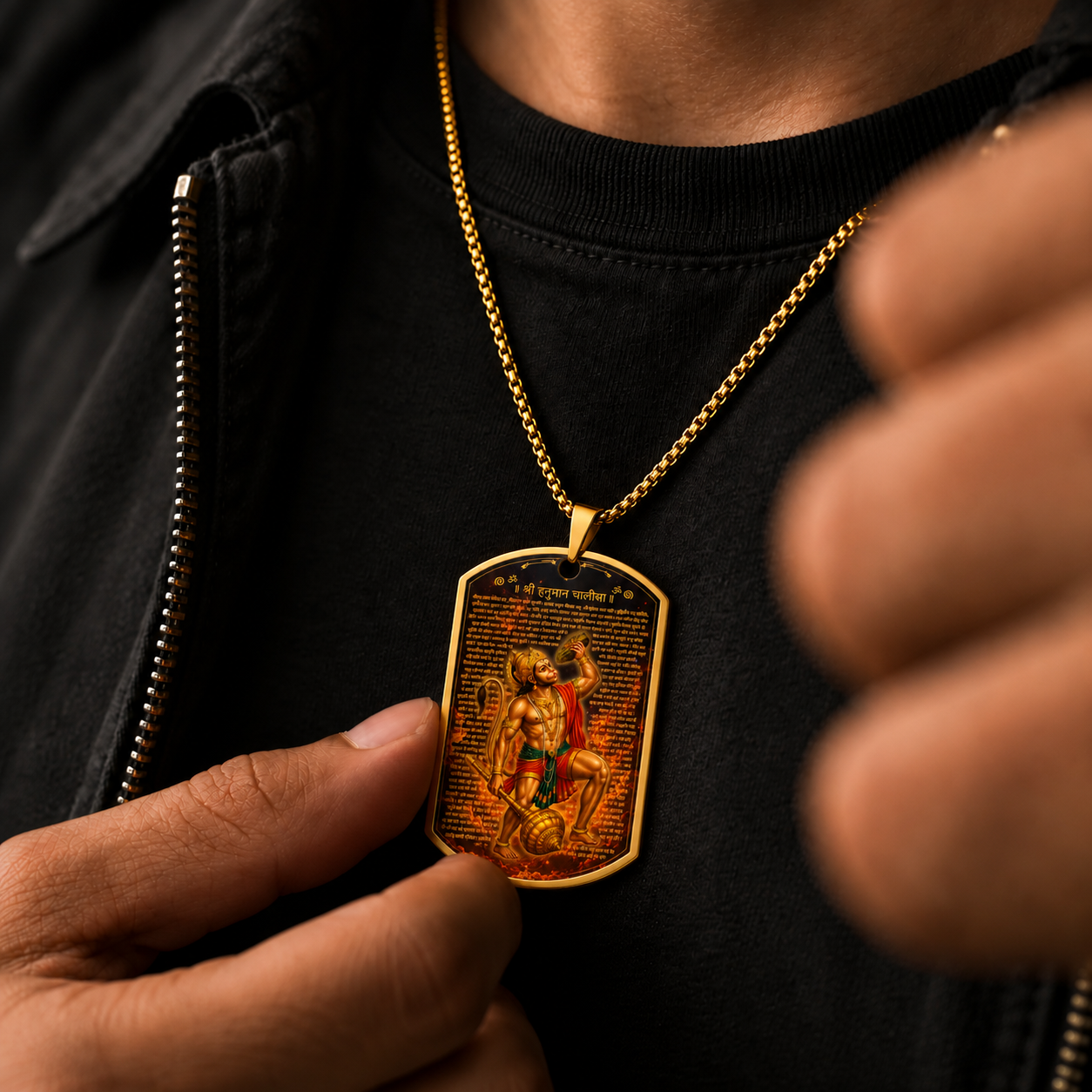
Walk into any jewellery shop in Old Delhi and ask for a Hanuman locket, and you will be shown ten completely different things. A tiny silver oval with an embossed face. A heavy gold pendant shaped like a mace. A five-faced figure you may not recognise. A flat disc covered edge to edge in tiny script.
They are all Hanuman lockets. They mean different things, they suit different people, and they cost wildly different amounts. This guide walks through each design so you know what you are actually looking at — and what to ask for.
What a Hanuman locket represents
Hanuman occupies an unusual place in Indian devotional life. He is the devotee rather than the deity being worshipped, and the qualities associated with him are practical ones: strength, loyalty, fearlessness, and service without expectation of return.
That is part of why Hanuman jewellery is worn so widely by people who would not otherwise wear devotional pieces. It reads less as ornament and more as a reminder of a particular way of carrying yourself. Devotees traditionally associate wearing an image of Hanuman with courage and protection, and many people receive their first one as a gift from a parent or grandparent rather than buying it themselves.
Tuesday and Saturday are the days traditionally set aside for Hanuman, which is also why many people choose those days to begin wearing a new piece.
The main Hanuman locket designs
1. The classic Hanuman ji portrait locket
The most common design by a wide margin. A round or oval pendant carrying Hanuman's face or a seated figure in relief, usually 15–25mm across.
This is the safe choice if you are buying for someone else and do not know their preferences. It is instantly recognisable, works on any chain, and suits every age group. Look at the depth of the relief when comparing pieces — cheap versions are stamped so shallowly that the features blur within a year of daily wear.
Best for: first-time buyers, gifting, everyday wear.
2. Panchmukhi Hanuman locket
Panchmukhi means five-faced. This design shows Hanuman with five heads — traditionally identified as Hanuman himself alongside Narasimha, Garuda, Varaha and Hayagriva, each facing a different direction.
The form comes from an episode in the Ramayana where Hanuman takes five faces to extinguish five lamps placed in different directions at once. In devotional tradition it is associated with protection from every side, which is why people looking into the benefits of a Panchmukhi locket are usually after something more specific than a general devotional piece.
It is a busier, more detailed design and needs a slightly larger pendant to work — under 20mm the five faces tend to merge into an indistinct mass. Buy this one large or not at all.
Best for: people who want the protective symbolism specifically; those who already own a plain Hanuman locket.
3. Hanuman gada locket
The gada is Hanuman's mace, and a gada locket drops the figure entirely in favour of the weapon. Usually a vertical pendant, 25–40mm long, sometimes with a small Hanuman face at the head of the mace.
This is the design that has quietly become the most popular among younger men, and it is easy to see why. It reads as strength without reading as overtly religious — it can pass for a straightforward masculine pendant while still carrying the meaning for the person wearing it. It also layers well with other chains, or with a Hanuman kada on the wrist.
One practical note: a long gada pendant swings more than a round locket. If the wearer is active or works with their hands, go shorter or choose a heavier chain that holds it flatter.
Best for: men in their twenties and thirties, gym-goers, anyone who wants something less literal.
4. Hanuman Chalisa locket
Instead of an image, this design carries the text. The Hanuman Chalisa — Tulsidas's forty-verse hymn — is engraved onto the surface of the pendant, often on both faces to fit the full composition.
The appeal is that you are carrying the words rather than a picture, which for a lot of devotees is the more meaningful thing. It also makes for a distinctive-looking piece: from a distance an engraved Hanuman Chalisa locket reads as a textured metal disc, and only up close does the script resolve.
Engraving quality is everything here, and it is where most cheap versions fail badly. Engraved text at this scale should be legible under a phone camera zoom. If the verses are decorative squiggles rather than readable Devanagari, the piece has been made to look like a Chalisa locket rather than actually be one. Ask to see a close-up photograph before buying online.
Best for: people who recite the Chalisa regularly; anyone wanting a piece that is not immediately identifiable across a room.
5. Hanuman yantra locket
A yantra is a geometric diagram used in worship, and a Hanuman yantra locket carries the specific diagram associated with Hanuman rather than his image — usually a square or circular pendant with concentric geometry and seed syllables.
This is the most specialised of the designs and the least common. People who want one usually know exactly why. If you are buying as a gift and the recipient has not specifically mentioned yantras, choose something else.
Best for: those following a specific devotional practice.
6. Modern and dog-tag styles
The newest category: Hanuman motifs on rectangular dog tags, minimal line-art pendants, blackened or matte-finish metal. These borrow the shape language of contemporary men's jewellery and put devotional imagery on it.
Worth considering for anyone who has never worn a locket and finds the traditional forms too ornate. The trade-off is that these designs date faster than classic ones.
Best for: teenagers and men who do not otherwise wear jewellery.
Choosing the metal
The design decides what the locket means. The metal decides whether it survives daily wear.
Sterling silver (925) is the default for good reason. It takes fine detail well, it is affordable enough to buy a larger pendant, and it can be polished back to shine indefinitely. It does tarnish — that is silver behaving normally, not a defect — and needs an occasional wipe with a soft cloth. Most silver Hanuman lockets sold in India sit in an accessible price band, which is why silver dominates this category.
Gold holds detail beautifully and never tarnishes, but the cost scales with pendant size, so gold Hanuman lockets tend to be small. That is a real constraint on detailed designs like Panchmukhi. Gold is also the traditional choice for a child's first locket.
Gold-plated brass or silver gets you the look of gold at a fraction of the price. Plating wears at contact points over time — how fast depends on thickness and how the piece is worn. A reasonable choice if you rotate between several pieces, less so for something worn every single day for years.
Stainless steel is the most durable and the least expensive. It will not tarnish, bend, or scratch easily, and it is genuinely the practical answer for someone who works with their hands or swims regularly. It cannot hold engraving as crisply as silver, so it suits bolder designs over fine ones.
Who you are buying for
For men: gada lockets and dog-tag styles dominate current demand. Size up — a 15mm pendant that looks right on a woman disappears on a wider chest. Pair with a 20–24 inch chain. Our Hanuman lockets for men are grouped in one place if you want to compare sizes side by side.
For women: classic portrait lockets in smaller sizes, often worn on a shorter chain as part of a layered look.
For children and babies: small, light, no sharp edges, and a short chain that cannot be pulled or caught. Gold is traditional for a first piece. Keep the pendant under 15mm and check that any hanging loop is soldered closed rather than just bent shut.
How to wear and care for it
Most devotees begin wearing a new Hanuman locket on a Tuesday or Saturday, and many rinse the piece and offer a brief prayer before wearing it the first time. These are customs rather than rules, and practice varies by family and region — if you have a family tradition, follow that.
Common practice among devotees includes removing the locket before bathing and keeping it away from leather, though again this differs household to household.
For upkeep, the essentials are simple. Take silver off before swimming, since chlorine attacks it. Put perfume and deodorant on before the locket rather than after. Wipe it with a soft dry cloth every week or two — that alone prevents most tarnish. Store it in a pouch rather than loose in a drawer, where it will scratch against other pieces. For engraved lockets, a soft dry toothbrush lifts dust out of the grooves without wearing the metal.
When to gift one
Hanuman Jayanti is the obvious occasion. Sawan sees a broad rise in devotional jewellery buying across India. Beyond the calendar, these are common as a first religious gift to a child, at a housewarming, before someone leaves home for a new city or job, and between brothers at Raksha Bandhan.
The reason it works as a gift is that it does not require the recipient to be especially religious to be worth wearing. It sits comfortably on someone who simply likes what it stands for. If you are still deciding, the full Hanuman collection is the easiest place to see every design together.
Frequently asked questions
Which Hanuman locket design is best for daily wear?
A classic portrait locket in sterling silver or stainless steel. Both are hard-wearing, and the shallow round shape does not catch on clothing the way longer gada pendants can.
What is the difference between a Panchmukhi and a regular Hanuman locket?
A regular locket shows Hanuman with one face. A Panchmukhi locket shows five faces pointing in different directions, and is traditionally associated with protection from all sides. Panchmukhi designs need a larger pendant to keep the detail readable.
Which day should I start wearing a Hanuman locket?
Tuesday and Saturday are traditionally associated with Hanuman, and many devotees choose one of those days. Customs vary between families and regions, so follow your own family's practice if there is one.
Can women wear a Hanuman locket?
Yes. There is no restriction in devotional tradition, and smaller portrait lockets are commonly worn by women.
Is silver or gold better for a Hanuman locket?
Silver lets you buy a larger, more detailed pendant for the same money and holds fine engraving better. Gold costs more and therefore tends to come in smaller sizes, but never tarnishes and is traditional for a child's first locket.
How do I check whether an engraved Hanuman Chalisa locket is genuine?
Ask for a close-up photograph and zoom in. Properly engraved verses are legible Devanagari script. If the text is decorative marks that do not resolve into words, the piece only imitates the design.
Will a silver Hanuman locket turn black?
Some tarnish is normal for silver and not a fault. A weekly wipe with a soft dry cloth prevents most of it, and a jeweller's polish restores the original shine.


Leave a comment
All comments are moderated before being published.
This site is protected by hCaptcha and the hCaptcha Privacy Policy and Terms of Service apply.